Officially retiring LabVIEW Robotics Blog March 30, 2012
Posted by emiliekopp in Uncategorized.add a comment
I’ve been awful at keeping up on this blog lately. It’s time I officially retire this blog.
While I’ve moved on to new focus areas, National Instruments, my employer remains committed towards delivering best-in-class design tools for robotics.
If you’re looking for robotics resources (how-to, code, video, etc.) be sure to visit the LabVIEW Robotics Code Exchange: ni.com/code/robotics.
Farewell. It’s been an amazing journey. Robots rock!
Robots rawk at NIWeek August 17, 2011
Posted by emiliekopp in robot events.Tags: dr_hong, humanoid, NIWeek, romela, superdroid, ugv, video
add a comment
Check out the some of the awesome robots featured in the Robotics Pavilion at 2011 NIWeek:
SuperDroid Robots showed off the SD6 robot, a super-rugged, treaded UGV that was developed jointly with NI.
Dr. Hong brought the latest and greatest from RoMeLa, showing off their full-size humanoid robot, CHARLI:
I got a picture with CHARLI and Dr. Hong as well:

You can download many of the presentations from the Robotics Summit from the NIWeek Community:
- Mobile Diagnostic Robot: Sense, Move, and Control
- Ultralean Robotic Solutions
- Controlling a Hyper-Dynamic Quadruped Robotic Platform With LabVIEW and NI Single-Board RIO
- FIRST Robotics Using NI LabVIEW and CompactRIO
- Early Experience Using LabVIEW Robotics With Industrial and Custom Serial-Linked Robots
- The Nitty Gritty Technical Details of the LabVIEW Robotics Module
- Open Control Architecture for an Industrial SCARA Robot
- Medical Simulations With Mechatronic Eyes
- Fuzzy Logic for Most of Us
And that’s not everything. Check out Brian Powell’s recap of all-things-robotic at NIWeek on the LabVIEW Field Journal blog:
LabVIEW Robotics at NIWeek 2011
U.S. Military Insect Drones (powered by LabVIEW?) July 15, 2011
Posted by emiliekopp in industry robot spotlight, labview robot projects.Tags: drone, insect, labview, mav, micro_aerial_vehicle, military
2 comments


Do the screens of any of the monitors look familiar?
Read the news coverage of this robots here:
Micro-machines are go: The U.S. military drones that are so small they even look like insects
Open Source Code: Using XBox Kinect with the LabVIEW Robotics Starter Kit May 25, 2011
Posted by emiliekopp in code, labview robot projects.Tags: kinect, labview, obstacle_avoidance, open_source, sensor_fusion, sonar, starter_kit, xbox
add a comment
This example features sensor fusion, using the Kinect to gather the 3D image of the world and a scanning sonar to help avoid obstacles that get too close for the Kinect to see.
Check out the full recipe on the NI Robotics Code Exchange, including hardware lists, software and setup requirements, as well as code descriptions and downloads.
Download: Using the XBox Kinect with LabVIEW Robotics Starter Kit
Kinect 6D Visualization in LabVIEW April 19, 2011
Posted by emiliekopp in code, labview robot projects.Tags: 3d, 6d, cloud, kinect, labview, obstacle_avoidance, point, robot, robotics, vision, visualization, xbox
2 comments
The LabVIEW Kinect code keeps rolling in. I am happy to share yet another example that is available for free download.
This one is very similar to John Wu’s LabVIEW + Kinect example I shared awhile back. Karl Muecke, NI R&D engineer, shares his 6D visualization example on the NI Robotics Code Exchange.

You can view a video screen capture of the demo and download his open source code here:
https://decibel.ni.com/content/blogs/MechRobotics/2011/04/19/kinect-6d-visualization-in-labview
More LabVIEW Development for the Xbox Kinect April 7, 2011
Posted by emiliekopp in code, labview robot projects.Tags: code, driver, kinect, labview, open_source, robotics, vision, xbox
3 comments
So remember when I said the Xbox Kinect was going to revolutionize robotics (at least from a sensor-hardware point of view)?
Well, when it rains, it pours: More and more LabVIEW developers are uniting, creating and sharing drivers that allow you to communicate with the Xbox Kinect hardware using LabVIEW software.
An NI Community member, anfredres86, has published his VI driver library, making it easy to download and install the necessary files for you to start developing robotics applications in LabVIEW that utilize the Kinect hardware for robot sensing.
Here is a video of the 2D occupancy grid mapping example he put together using LabVIEW and the Kinect:
I encourage everyone to check out (and download) his code:
Kinect Drivers for Labview: http://decibel.ni.com/content/docs/DOC-15655
And be sure to share your examples on the NI Robotics Code Exchange as well!
Open Source Code: Using LabVIEW to Acquire iPhone Accelerometer Data April 1, 2011
Posted by emiliekopp in code, labview robot projects.Tags: accelerometer, code, control, iphone, labview
add a comment

Ok, so this week’s post proves that I simply can’t get enough of John Wu’s blog, RIOBotics. John is cranking out LabVIEW code for robotics applications , left and right.
This time, John helps you use LabVIEW to acquire and plot data directly from your iPhone’s accelerometer through UDP. (I bet this is similar to how Waterloo Labs was able to build an iPhone app that allowed them to steer a car by tilting their iPhone from side to side.)
Xbox Kinect Hack Using LabVIEW March 7, 2011
Posted by emiliekopp in code, labview robot projects.Tags: 3d, code, example, kinect, labview, open_source, visualization
3 comments
If you haven’t seen this already, you need to. The Xbox Kinect is not only revolutionizing gaming, it will revolutionize the way humans interact with machines, including robots (think: robots can now more easily interpret human gestures).

Ryan Gordon, from http://ryangordon.net/, got things started by building and sharing a LabVIEW wrapper for the OpenKinect library. Then John Wu, another LabVIEW programmer, took things one step further building an example VI for 3D scene construction using the Kinect sensor and point clouds.
Download John’s example on his blog post: LabVIEW, Xbox Kinect, and 3D point cloud visualization
Thank you John and Ryan! This is the beginning of some incredible and exciting work!
DARPA Arm Robot Controlled via LabVIEW January 25, 2011
Posted by emiliekopp in code, labview robot projects.Tags: arm, code, control, darpa, labview, simulator
add a comment

By now, you’ve all heard of one of DARPA’s latest robotics projects, but just in case:
DARPA is introducing its Autonomous Robotic Manipulation (ARM) program. The goal of this 4 year, multi-track program is to develop software and hardware that allows an operator to control a robot which is able to autonomously manipulate, grasp and perform complicated tasks, given only high-level direction. Over the course of the program in the Software Track, funded performers will be developing algorithms that enables the DARPA robot to execute these numerous tasks. DARPA is also making an identical robot available for public use, allowing anyone the opportunity to write software, test it in simulation, upload it to the actual system, and then watch, in real-time via the internet, as the DARPA robot executes the user’s software. Teams involved in this Outreach Track will be able to compete and collaborate with other teams from around the country.
One of NI’s R&D engineers, Karl, has developed a LabVIEW wrapper for the DARPA arm simulator in his spare time and has graciously shared it on the NI Robotics Code Exchange (ni.com/code/robotics).
Using Karl’s code, you can directly control the arm simulator using LabVIEW. This means you develop your own control code and easily create UIs using LabVIEW’s graphical programming environment (two of the things LabVIEW is best for).
Check out Karl’s blog to request the code:
Last chance to vote: Help name the new NI robotics product November 23, 2010
Posted by emiliekopp in industry robot spotlight.Tags: poll, robotics, starter_kit
add a comment
Rumor is the NI R&D team is developing a new robotics starter kit. I’ve seen some early prototypes and while I can’t provide any specs (without losing my job, of course), I can divulge that the team is looking for outside help. Specifically, they need outside opinion on what to name the new robot. What do you think it should be?
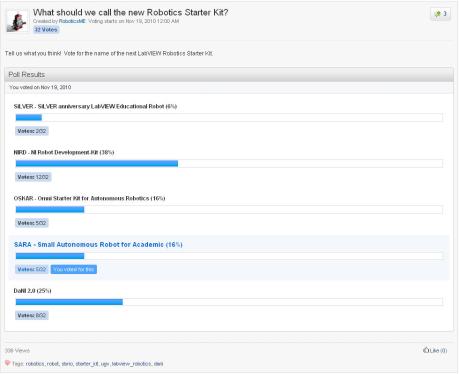
Visit the NI Robotics Code Exchange to cast your vote.
Hurry because the poll ends soon.
 subscribe by email
 LabVIEW Robotics